


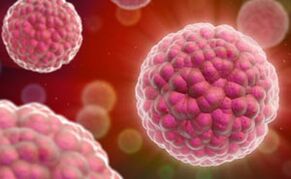
Human papillomavirus (HPV) is a specific pathogen that causes a chronic infectious disease called human papillomavirus infection, the most common infection in humans.
Modern medicine knows many types of these microorganisms, each of which has different manifestations: warts on the skin of the legs, hands and other parts of the body, genital warts on the mucous membranes of the genitals.HPV resides only in the basal layer of the skin and is transmitted sexually.
Alike
There are a large number of viruses.Some of them are completely harmless to humans.However, about 40 types of HPV cause the development of genital warts in both men and women.And there are substances that stimulate the growth of malignant cells.
Of all known human papillomaviruses, the most common types are:
- HPV, which causes plantar warts, has a callus-like appearance;
- HPV causes the development of flat warts;
- HPV, which causes the development of common warts;
- HPV, which causes the development of genital warts and papillomas on the genitals in men and women;
- HPV, which causes a precancerous rash.
Based on their ability to develop cancer, all HPV types are divided into safe viruses, low cancer risk viruses, and high cancer risk viruses.The latter is observed on the genitals of men and women in the form of genital warts and papillomas.If growths of this type are detected, their urgent removal is necessary.
How is it transmitted?
Human papilloma virus is very contagious.The infection itself in most cases occurs in childhood, during the child's active exploration of the world around him, during which damage to the child's skin (scratches, abrasions) occurs.It is through such lesions that the papillomavirus enters the child's body.
Some strains of the virus cause the development of genital warts in adults.The mechanism of transmission in this case is purely sexual.The virus enters through small wounds of the genitals from one partner to another, including through anal intercourse, as well as oral sex.
In addition, there are several ways human papillomavirus is transmitted:
- Transmission of the virus from mother to child during childbirth.In this case, the growth of papillomas in newborns occurs on the mucous membranes of the mouth and throat, as well as in the anus and genital area;
- autoinfection, in which the virus is transmitted during shaving or hair removal from one part of the body to another;
- transmission of the virus through household means (in the bathroom or swimming pool).
Symptom
The immune system of a healthy person is able to overcome the activity of the virus at the early stages of its development, and therefore in most cases the human papilloma virus does not manifest itself in any form.Reduced immunity allows the virus to become more active, leading to the appearance of characteristic clinical symptoms.Concentrating in a certain place on the skin or mucous membrane, the virus disrupts the reproductive processes of cells, accelerating their division.In this case, the growth that appears characterizes the presence of the virus in the body.The growths can be in the form of papillomas, genital warts, and warts.
A papilloma is a soft, elongated tumor that attaches to the skin by a stalk.Most often, papillomas form under the mammary glands in women, in the armpits, groin, on the neck and in some cases on the face.The number and size of papillomas are increasing rapidly.
Warts are round, hard, rough spots with clear boundaries, 2 mm to 1 cm in diameter.They form most often on the hands, elbows, and knees.
Condyloma acuminata are tumors that grow quite soft, have a rough surface, and cling to the skin by stalks.Usually they form in the area of the external genitalia and anus.The distinguishing feature of genital warts is their rapid growth in the form of clusters or cauliflower.
In women
When entering the female body, the human papilloma virus causes the appearance of genital warts or papillomas on the genitals (between the ages of 15 and 30), and also often leads to the development of cervical erosion and dysplasia.As a rule, the first tumors appear within three months from the moment of infection and in most cases are located in the labia minora, in the cervical canal, on the skin around the anus and in the oral cavity.Infection can exist in the female body for a long time without manifesting itself in any way.The onset of menopause activates the virus, which can cause malignancy of the mucous membrane cells of the genital organs.
In men
A characteristic feature of papillomavirus in men is the long and asymptomatic development of the disease.Against the background of stable immunity, the virus has no external manifestations.But factors such as hypothermia, overwork and infectious diseases can significantly reduce the level of immunity, leading to the appearance of the first clinical signs in the form of tumors on the skin and mucous membranes.Men can develop genital warts (genital papillomas), their preferred habitat is the anus and penis.Men can also get recurrent laryngeal papillomas.
Treatment of human papillomavirus
Modern medicine does not have a special drug that can fight human papilloma virus.Most tumors disappear on their own within 6 months to 3 years.A previously transmitted virus develops lifelong immunity in the body.
Treatment of HPV in the majority of cases is not aimed at eliminating the pathogen, but at eliminating external manifestations of its activity.Warts and papillomas are removed in cases where they are cosmetically unpleasant or painful.Genital wart removal is mandatory for both men and women.The main methods of removal are: electrocautery with electric current, cold destruction with liquid nitrogen.
Treatment of papillomas and warts includes the use of the following medical procedures:
- Treat warts daily with 20% salicylic acid solution for a long time;
- injection into the source of infection;
- topical treatment of warts with cream;
- burn papillomas and warts with special preparations;
- cryotherapy (removes the tumor in 3-4 sessions);
- Laser treatment (1-3 sessions).
Treat diseases with folk remedies
Treatment of HPV involves the use of traditional medicine methods.The most popular of them include:
- Treat warts with juice of celandine, dandelion, green apple, aloe;
- porridge compress made from rabbit cabbage leaves, frozen rowan, garlic, Kalanchoe;
- bath with a strong mixture of St.John's wort and chamomile;
- Treat warts with a decoction of willow bark mixed with vinegar.
You should not expect immediate recovery after treatment with folk remedies.This is a long and persistent process.But patience and perseverance will be rewarded with positive results.